

Carpenter Ants
Carpenter Ant Control in Orlando, Florida
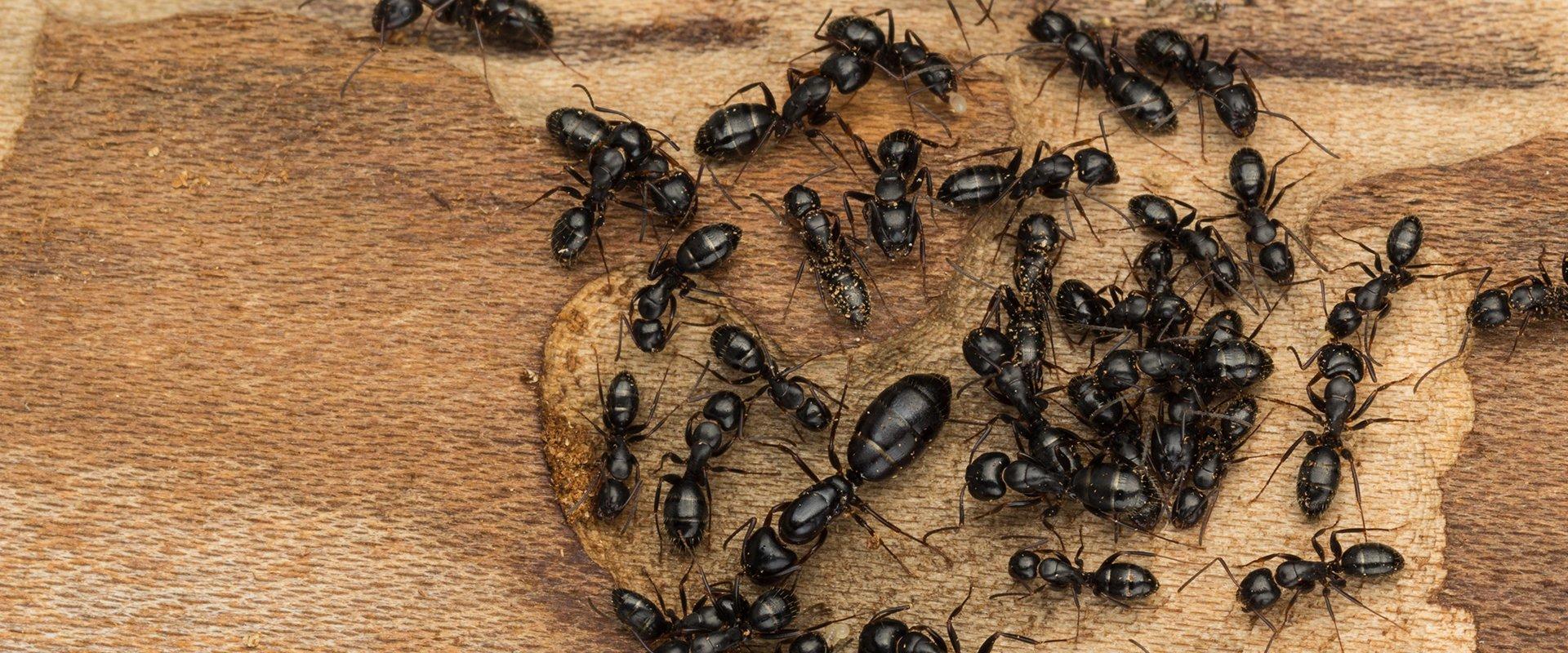
The carpenter ant you see in Orlando is usually the Florida carpenter ant, Camponotus floridanus, and it does not look like the solid black carpenter ant people picture. It is bicolored, a reddish orange head and thorax with a black abdomen, and it is big, up to about half an inch. There is a second species here, Camponotus tortuganus, that is lankier and more uniformly amber.
They are night foragers. If you are seeing large ants on the kitchen counter after dark, on the lanai, or running a trail along a soffit line or a cable, that is the pattern. During the day they are quiet.
Carpenter ants do not eat wood, they move into it
Unlike termites, carpenter ants get no nutrition from wood. They excavate galleries in it to nest, which is why the tell-tale sign is not mud but a small pile of what looks like coarse sawdust, often with insect parts mixed in, under a window frame or at the base of a wall.
And they will not excavate sound, dry lumber if they can avoid it. In Central Florida a carpenter ant problem inside a structure almost always means water got somewhere it should not have: a roof leak over a soffit, a window that was never flashed properly, a shower pan, an AC line set sweating inside a wall, or a fascia board that has been wet long enough to soften.
Most Orlando colonies are outdoors
This is the part that separates Florida from the north. Here the main nest is very often in a tree hollow, a dead palm boot, a stump, a landscape timber, or under mulch, and the ants are simply foraging into the house along a branch touching the roof or a wire entering a soffit. Spraying the ants you see on the counter accomplishes nothing in that situation.
What we actually do
We find where they are coming from before we treat anything: trailing at night if that is what it takes, checking the roof line, the soffits, the irrigation-soaked side of the house, and the trees within reach of the structure. Then we treat the nest and the trail with non-repellent products the workers carry back, and we tell you plainly which branch needs cutting back, which board is wet, and what has to be fixed so they do not come straight back.
Carpenter ants are also a wood-destroying insect, so if you are in a real estate transaction, ask about a WDO inspection at the same time.
Call 407-580-7124.

Satisfaction Guaranteed
If we find that your ant problem is really a moisture problem, we will tell you that rather than sell you a treatment plan that will not hold.