

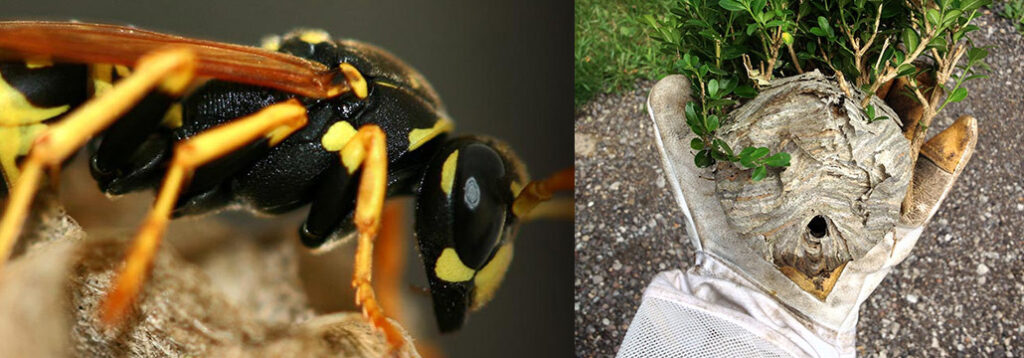
Yellow Jacket Nest Removal in Orlando, Florida
Yellow jackets are the reason most stinging insect calls in Central Florida sound urgent. Unlike paper wasps, which build an open comb you can see from twenty feet away, yellow jackets nest out of sight, in the ground, in a wall void, under a deck, inside a soffit or behind siding. People usually find them by accident, with a mower, a strimmer, or a hand reaching into the wrong place.
They also sting repeatedly. A honey bee stings once. A yellow jacket colony will pursue and sting a person over and over, and in Florida a mature late-season nest can hold thousands of workers.
How to tell it is a yellow jacket nest
- Steady two-way traffic through a single small hole. A hole in the lawn, a gap at a soffit corner, a crack in stucco, a weep hole, or a knot in a fascia board. Watch it for thirty seconds from a safe distance: if insects are going in and out in a constant stream, that is a nest, not a passing wasp.
- Fast, direct flight. Yellow jackets fly straight and quick. Paper wasps hover and dangle their legs.
- Yellow and black banding, no fuzz. Yellow jackets are smooth and shiny. Honey bees are fuzzy and mostly amber-brown, and if what you have is honey bees in a wall, that is a beekeeper or a licensed live-removal job, not an extermination.
- Interest in food and drink. Late in the season yellow jackets switch from hunting insects to scavenging sugar, which is when they start showing up at cookouts, garbage cans and soda cans.
Where they nest on Central Florida properties
Ground nests along fence lines, in mulch beds, under shrubs and in old rodent burrows. Wall voids and soffits, usually entered at a gap in the fascia or a stucco crack. Under decks and pool cages. Inside irrigation and utility boxes. In sheds, grills and playsets that have sat unused for a few weeks. In palm boots and hollow tree limbs.
Because Central Florida stays warm, colonies here get started earlier and keep building later than they do further north, so a nest that was small in April can be enormous by September.
Why the hardware store can does not work
A consumer aerosol is designed to knock down insects it directly contacts. It does not reach the brood chamber three feet down a ground nest or two feet into a wall cavity. What it reliably does is agitate the colony, and a partly treated yellow jacket nest is far more dangerous than an untreated one. Sealing the entry hole is worse still: the colony chews a new exit, and in a wall void that new exit is often into the room on the other side.
Pouring petrol, boiling water or bleach into a ground nest is dangerous, illegal in some circumstances, and does not reach the queen.
How we handle it
We treat the nest itself, at the entrance and into the void or burrow, using a product and an application method suited to where the nest actually is. Timing matters: treating at dusk or early morning, when the foragers are home, deals with the whole colony rather than the fraction that happened to be inside.
Where the nest is in a structure, we treat the void so the colony dies in place rather than relocating deeper into the wall, then remove the nest where it can be removed, because abandoned comb and dead brood attract carpet beetles, ants and roaches. Where an eave or a soffit gets a nest every single year, we can treat it before the season starts, which is far cheaper than an emergency call in August.
If someone in the house is allergic
Say so when you call and we will move you up the schedule. Anyone who has had a systemic reaction to a sting should not be anywhere near the property during treatment, and should have an epinephrine auto-injector on hand. A sting reaction that involves swelling away from the sting site, difficulty breathing, or dizziness is a medical emergency, not something to sit out.
We handle the rest of the stinging insects too, on our wasp and hornet control page, and exterior stinging insect coverage is included in the Ultra Yard Plan.
Call 407-580-7124.